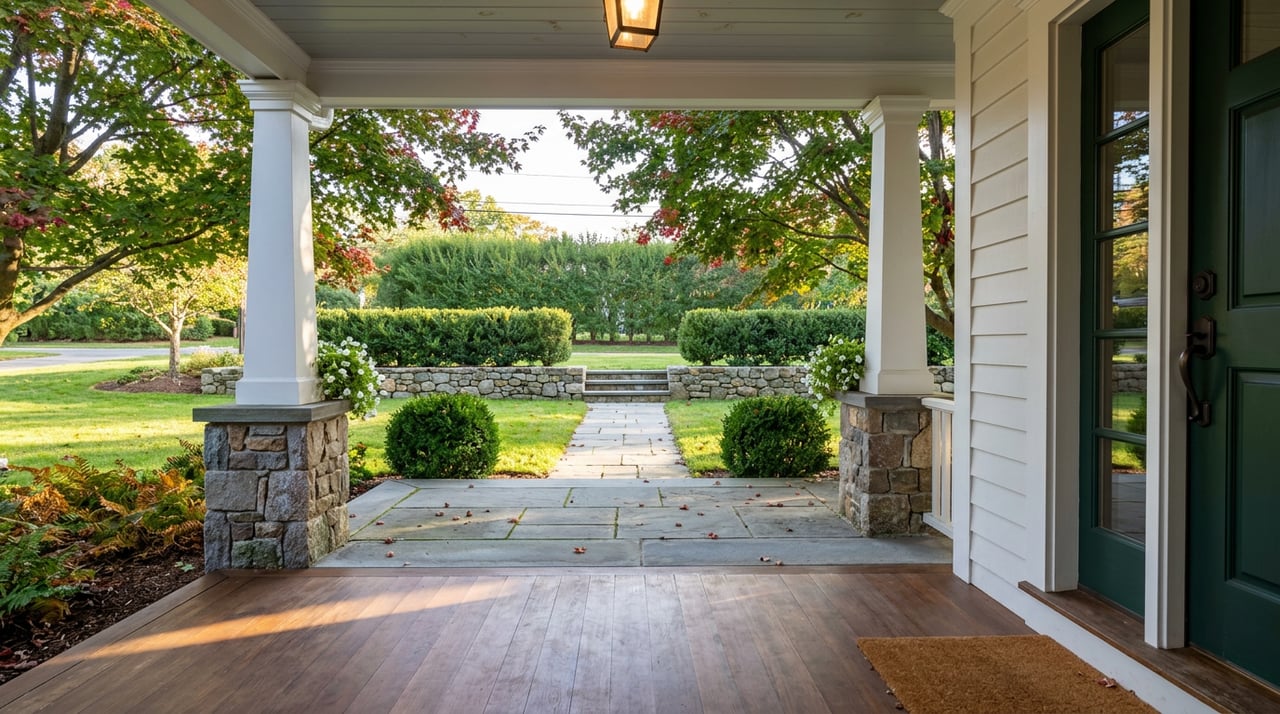
Same Address, Different Tax Bill: The Line Every Christiansburg Buyer Should Ask About
August 13, 2026
August 13, 2026
Picture two houses in Christiansburg, same price, same square footage, ten minutes apart. One sits inside the town limits. The other sits just outside them in unincorporated Montgomery County. Assessed at the same value, the in-town house will carry a real estate tax bill that runs several hundred dollars a year higher than its neighbor's. This difference may not be apparent from price and square footage alone. Check the parcel's tax jurisdiction before making an offer.
That gap reflects a layer of local government that affects the tax bill for properties inside town limits, and it just got more expensive this year.
Montgomery County levies a real estate tax on every parcel in the county, town or no town. But Christiansburg and Blacksburg are incorporated towns inside the county, which means each one is allowed to add its own levy on top of the county rate for any property that falls inside its town limits. The Town of Christiansburg's own tax page states it directly: "as a town resident, you are subject to taxation by both jurisdictions."
The two towns do not charge the same amount for the privilege. Based on the Virginia Department of Taxation's tax year 2025 local rates survey, Christiansburg adds $0.14 per $100 of assessed value on top of the county rate, while Blacksburg adds $0.26 per $100. Here is what that looks like on a home assessed at $300,000, using the county's current rate:
| Where the parcel sits | Combined rate per $100 | Annual tax on a $300,000 assessment |
|---|---|---|
| Unincorporated Montgomery County | $0.81 | $2,430 |
| Inside Christiansburg town limits | $0.95 | $2,850 |
| Inside Blacksburg town limits | $1.07 | $3,210 |
That is a $420-a-year difference between an identical house inside Christiansburg's line and one just outside it, and a $780-a-year difference against a comparable house inside Blacksburg. Multiply either gap over a 10-year hold and you are looking at real money to factor into your comparison beyond the figures shown in a search filter.
The county-wide baseline in that table is not last year's number. On April 20, 2026, the Montgomery County Board of Supervisors voted 5-2 to raise the real estate tax rate from 76 cents to 81 cents per $100 of assessed value for fiscal year 2026-27, according to Cardinal News and WDBJ7. County officials said most of the new revenue is earmarked for employee pay, with the majority going toward Montgomery County Public Schools compensation. The increase took effect at the start of the new fiscal year on July 1, so anyone closing on a Christiansburg property right now is already paying under the higher rate.
Not every supervisor agreed it was the right call. District D Supervisor Todd King argued against the hike during the board's work session, telling WFXR that "I just do not feel like this is the time to raise taxes." The board's chair countered that meeting every funding request from the county and school system would have required a 12-cent increase rather than five.
Whatever side of that debate you land on, the practical effect for a buyer is the same. The county rate used to calculate every dollar figure in the table above is five cents higher per $100 than it was a year ago.
It is tempting to read the table above as a simple argument for buying just outside the town line and pocketing the difference. That misses what is happening along the Peppers Ferry Road corridor.
A Roanoke Times report on development activity in that part of town described it as "the rapidly growing part of town that is served by Peppers Ferry Road." The projects moving through the town's approval pipeline back that up. Recent entries on the town's Plans in Review page and prior coverage point to:
None of this is speculative planning on a shelf. The projects and proposals reflect development activity in the exact area where a lot of the town's incorporated-limits housing sits. They include roads, sidewalks, and parks in the same corridor where new rooftops are going up.
Here is the reframe worth sitting with before you rule a listing in or out based on a jurisdiction line. The question is not "town or county, which costs less." It is "how does the added tax cost compare with this specific parcel's proximity to planned and ongoing development?"
A house inside Christiansburg's limits but nowhere near Peppers Ferry is paying the same $0.14 premium as one three blocks from the proposed connector road and the future park, though the two locations differ in proximity to those projects. A house just outside the line but a short drive from the corridor's new retail and restaurant investment gets a lot of the convenience without the town tax at all. The line on a map and the line on a tax bill do not always track with the line that actually determines day-to-day value.
That is the calculation worth running before you compare two listings on price alone: not just what jurisdiction a parcel sits in, but what that jurisdiction is currently building near it.
Does every address with a Christiansburg mailing address fall inside town limits? No. Christiansburg's ZIP code covers a wide area, much of it in unincorporated Montgomery County. A mailing address alone does not tell you which tax jurisdiction applies. That has to be confirmed at the parcel level.
Will the county rate change again next year? Rates are set annually by the Board of Supervisors and there is no way to predict next year's vote from here. What is known is that the current $0.81 county rate and the $0.14 Christiansburg add-on are both in effect for fiscal year 2026-27, which is the year any closing happening right now falls under.
How do I find out if a specific property sits inside Christiansburg's town limits? The most reliable way is to check with Montgomery County's real estate assessment records or ask directly during a showing. Two houses on the same road can sit on opposite sides of a limits line that is not visible from the street.
If you are weighing a Christiansburg property against one in the surrounding county, or trying to figure out whether a specific address near Peppers Ferry Road is worth the added town levy, that is exactly the kind of parcel-by-parcel homework Wendy Swanson and the Swanson Team do before you ever write an offer. Reach out and we will pull the specifics on any address you are considering, tax jurisdiction included, so you can account for the number before making an offer.
This article is general information, not legal, tax or financial advice. Consult a qualified professional about your situation.


We treat every client like a longtime friend, guiding each step with honesty, care, and a commitment to protecting your investment.

The Swanson Team
Address 3681 Yellow Sulphur Rd Ste 1A Blacksburg, VA 24060