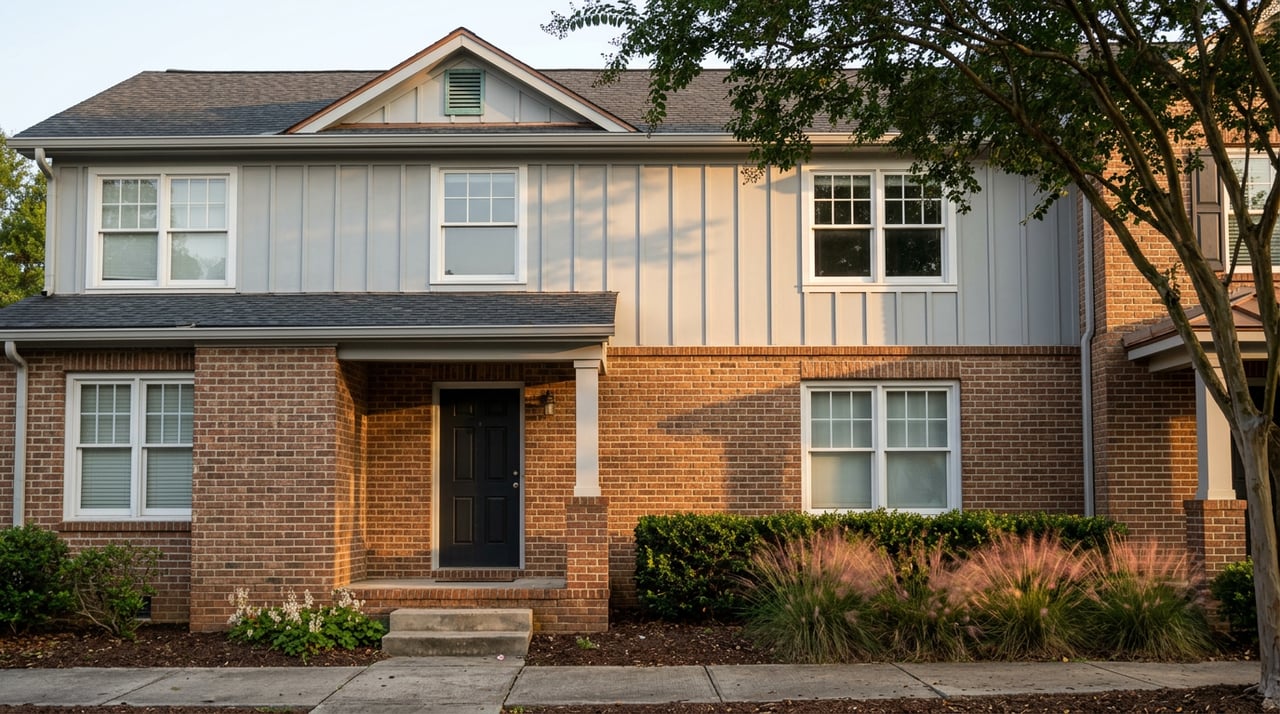
Comparing Christiansburg Townhome Prices, Incentives, and Payments
August 13, 2026
August 13, 2026
Why does the same townhome in Christiansburg cost $1,812 a month at closing and $2,171 a month two years later? That is not a rhetorical question. It is the actual payment schedule Ryan Homes is publishing right now for a unit at Walnut Creek Towns, and it is worth understanding before you compare that price tag to anything on the resale market.
Christiansburg has two new-construction communities selling hard at the moment, Walnut Creek Towns near the I-81 and Route 460 interchange and Clifton Town Center on Peppers Ferry Road, plus an older subdivision, Oak Tree, that is quietly doing both resale and new construction under the same name. Each offers a different point of comparison for buyers weighing new construction and resale. If you are cross-shopping new build against resale this year, the "starting from" number on a builder's sign is not the number you should be comparing to a resale listing. Here is how the numbers compare.
Ryan Homes' published example for Walnut Creek Towns is built on a $299,990 purchase price, FHA financing, and 3.5% down. The rate does not stay put.
| Year | Rate | Principal & Interest | Total Monthly Payment |
|---|---|---|---|
| 1 | 3.99% | $1,405 | $1,812 |
| 2 | 4.99% | $1,579 | $1,986 |
| 3 through 30 | 5.99% | $1,764 | $2,171 |
That is a 2-1 buydown. The builder subsidizes the rate down for the first two years, then the loan settles into its actual note rate for the remaining twenty-eight. The payment a buyer sees advertised, $1,812 a month, is not the payment they will carry for the life of the loan. By year three, the total payment is $359 higher, an increase of nearly 20% from where it started. The amortization schedule shows how the payment changes over time, a useful detail when comparing offers.
Here is the part that took a second look. The rate this loan settles into after the buydown expires, 5.99%, is itself below the going rate. Freddie Mac's Primary Mortgage Market Survey put the national average 30-year fixed rate at 6.69% for the week ending August 6, 2026, up slightly from 6.66% the week before. That means even the "real" long-term rate baked into this Walnut Creek Towns example sits seven tenths of a point under the national average the same week.
That gap has to come from somewhere. It is typically funded through builder concessions, discount points paid by the builder or its affiliated lender, or some combination baked into how the deal is structured, not simply lender generosity. A resale seller in Christiansburg does not have an in-house mortgage arm to underwrite that kind of gap. What a resale seller can offer is a price reduction or a credit toward closing costs, which is a fundamentally different lever than a subsidized rate schedule. When you put a builder's advertised payment next to a resale asking price, you are not comparing two prices. You are comparing a price against a financing structure, and only one side of that comparison is a fixed number.
Clifton Town Center is taking a different approach entirely. Stateson Homes is building this one as a mixed-use development directly across from Huckleberry Park, with townhomes currently listed starting around $344,900 and a "$10,000 bonus savings" being advertised for early buyers in the community's pre-selling phase. That is a flat discount, not a rate mechanism, which makes it easier to compare on paper but does not make it free. A $10,000 credit against a $344,900 townhome is roughly a 3% reduction, worth knowing exactly because it is simple, unlike the Walnut Creek Towns schedule, where the payment changes after two years.
Stateson Homes president Todd Robertson described the buildout to WDBJ7 last October:
"We have spent the last year putting in all the infrastructure and storm water management facilities and we've just recently paved a section of it."
The first phase, 22 townhomes, was slated for completion by this past May with sales opening in November 2025. Construction on an apartment building at the site was set to begin in January 2026, and the Town of Christiansburg's own permit records confirm it: a four-story, 27-unit apartment building on Parcel K, valued at $4.75 million, permitted this year. If you buy at Clifton Town Center, you are not buying into a quiet residential pocket. You are buying into a town-center concept that includes rental apartments next door, and that is worth weighing against a purely residential subdivision before you sign anything.
Oak Tree is the closest thing Christiansburg has to a resale benchmark for this product type, and it complicates the comparison in a useful way. Some Oak Tree townhomes on the market now were built in 2001, with vaulted ceilings and gas fireplaces that read as established rather than new. But the Town of Christiansburg's March 2026 permit report lists active plan revisions for Oak Tree Phases XI, XII, and XIII, meaning the same subdivision name covers both a 25-year-old resale unit and a brand new one still moving through permitting. A buyer who assumes "Oak Tree" means one consistent price point is making an assumption the town's own records do not support.
If you are looking at an Oak Tree listing, it is worth a direct question to the listing agent or the seller: which phase is this, and when was it actually built? The answer changes what a fair price looks like far more than the subdivision name does.
Christiansburg's citywide numbers give you the backdrop for comparing new construction and resale right now. The town's median sale price across all home types was $322,307 in May 2026, down 5.4% from a year earlier. By July 2026, the median list price across the town had drifted to $369,000, down slightly both month over month and year over year, with the median price per square foot down 5% from July 2025 and homes still taking about 35 days to sell. As of early August 2026, new-construction listings in town were carrying a median asking price near $357,000, roughly $35,000 above the citywide sale median. The difference gives buyers another point of comparison when considering new-construction prices and incentives.
A few questions worth asking before you compare any two numbers side by side:
What exactly is a 2-1 buydown, and who pays for it? It is a temporary rate reduction, typically two points below the note rate in year one and one point below in year two, funded upfront by the builder or its lender and held in an account that covers the difference each month until the loan reverts to its full rate in year three.
Does the builder's price already include the incentive, or is it added on top? In the Walnut Creek Towns example, the $299,990 price and the rate subsidy are presented as separate line items, but that is not guaranteed community to community. Always ask the builder directly whether the advertised price already reflects any incentive before you compare it to a resale listing.
How do I know if an Oak Tree address is new or resale? Ask the listing agent for the phase and the year built, or check the Town of Christiansburg's plans-in-review records directly, since active phases are listed there by name.
If you are trying to make sense of what a new construction payment schedule actually means for your budget, or how a specific Oak Tree, Walnut Creek, or Clifton Town Center address stacks up against what else is on the market, Wendy Swanson and the Swanson Team can walk through the real numbers with you, not just the ones on the sign out front.
This article is general information, not legal, tax or financial advice. Consult a qualified professional about your situation.
We treat every client like a longtime friend, guiding each step with honesty, care, and a commitment to protecting your investment.

The Swanson Team
Address 3681 Yellow Sulphur Rd Ste 1A Blacksburg, VA 24060