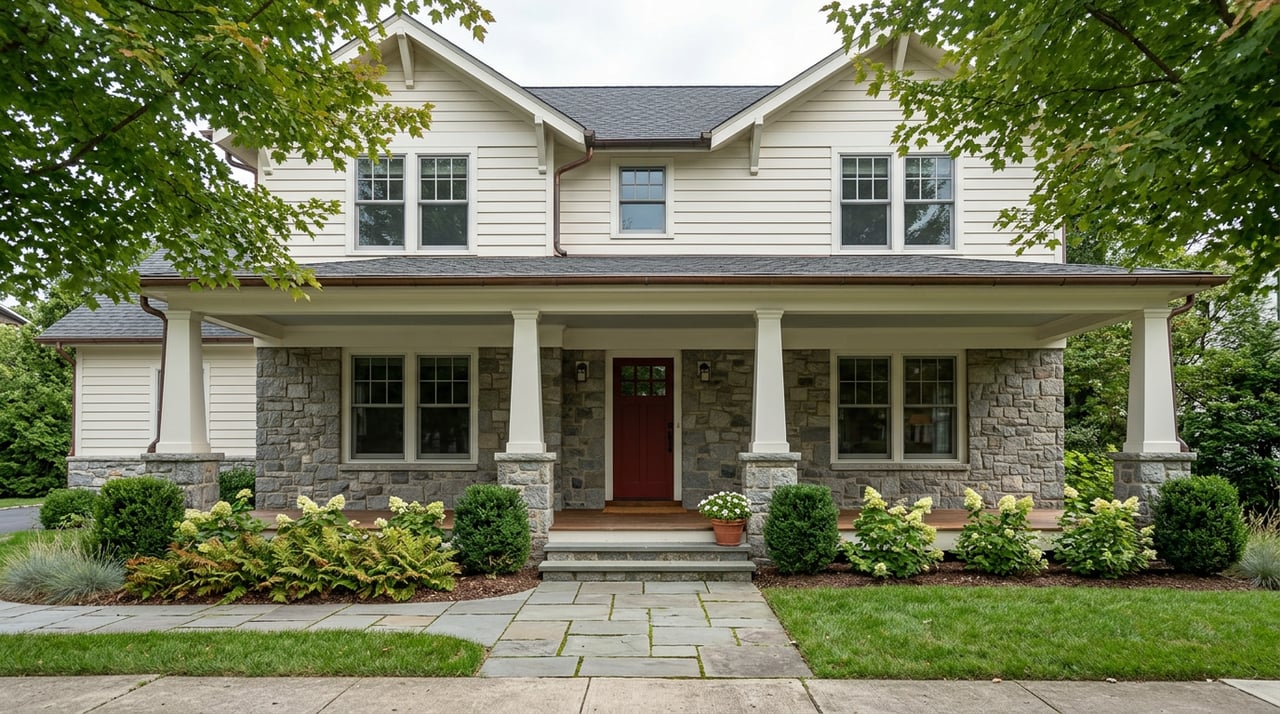
What the Blacksburg Median Actually Buys, and Why the Neighborhood Line Matters More Than the Number
August 6, 2026
August 6, 2026
Pull up three national portals for Blacksburg and you will get three different medians. One shows around $335,000. Another lands near $445,000. A third puts the 2025 sale median at roughly $460,000. All three are looking at the same town in the same year.
That gap is not a data error. It is the story.
Blacksburg does not have one housing market. It has two, sitting on top of each other, priced by different buyers, and the "median" is what falls out when you average them together.
If you are moving here and comparing neighborhoods on a portal map, this is the piece of local context the map cannot show you. What your dollar buys in Blacksburg depends less on how much you spend and more on which of the two markets you are shopping in.
Blacksburg's neighborhood-level medians span nearly a three-times range inside the town line. Rough submarket medians reported through spring 2026:
| Submarket | Typical single-family median | Who is buying |
|---|---|---|
| Ellett-Jennelle | around $265,000 | investors, first-time buyers, VT parents |
| Hethwood-Prices Fork | around $389,000 | move-in-ready buyers, VT-adjacent families |
| Downtown Blacksburg (SFH) | around $400,000 | walkable-lifestyle buyers, parents of students |
| Kabrich Crescent, McBryde, Farmview-Ramble | mid $400s | mid-career families, faculty |
| Tom's Creek, Woodbine-Wyatt | around $599,900 and up | established families, senior professionals |
Downtown gets even noisier at the top. Redfin's three-month rolling median for Downtown Blacksburg through May 2026 came in at $735,000, which is almost double what a small-lot downtown single-family typically closes for. That number is not wrong. It reflects a handful of large historic properties and new upper-tier townhomes changing hands in a low-volume submarket, which is exactly what a rolling median does when the mix shifts. Take it as a signal about who is entering downtown at the top end, not as the price of a downtown house.
The through-line: pick a Blacksburg number off a portal, and you are getting a weighted average of two economies that behave very differently.
The reason the medians fan out is that Blacksburg has two distinct sources of demand, and they want almost nothing in common.
The campus-adjacent tier. Condos, townhomes, and older single-family houses within walking or short-bus range of Virginia Tech. This is where you will find the entry price points, and it is not entry-level by accident. Two overlapping buyer pools compete for this stock: parents purchasing a place for a student to live for four years, and investors running student rentals on a predictable lease cycle tied to the academic calendar. Both pools care more about proximity, HOA rental rules, and turnover than about square footage or lot size. That keeps prices firm in the entry tier even when the broader town cools.
The research-park tier. North-of-town neighborhoods like Tom's Creek and Woodbine-Wyatt, plus the newer construction along that corridor, price off a different engine entirely. The Virginia Tech Corporate Research Center sits on roughly 230 acres next to campus, spans about 40 buildings, and hosts more than 230 tenant organizations. It has been building out shared lab space with GO Virginia funding and recently launched an Entrepreneur Resource Center. The people employed there, along with faculty at the university and clinicians tied to Carilion and the Fralin Biomedical Research Institute, buy the family-tier homes. They want school proximity, larger lots, and quiet.
Between those two ends sits the middle: Hethwood-Prices Fork, Kabrich Crescent, McBryde, Farmview-Ramble. This is where the bulk of transactions actually happen, and it is the tier where a relocating buyer without a Virginia Tech connection is most likely to land. It is also the tier most sensitive to interest-rate shifts, because the buyers are financing full purchases rather than deploying cash from a home sale elsewhere or writing tuition-plus-real-estate checks.
The practical read: if you are comparing "Blacksburg" to another town by portal median, you are comparing an apple to a fruit salad. Compare submarket to submarket instead.
Montgomery County's real property tax rate sits at 0.77 percent. Roanoke's is 1.01 percent. On a $460,000 home, that is roughly $3,542 a year in Montgomery versus about $4,646 in Roanoke, a difference of a little over a thousand dollars annually before any other adjustments.
That gap does two things to the market you are shopping.
First, it means Blacksburg buyers can carry a slightly higher purchase price at the same monthly payment as a Roanoke buyer at a lower one. Part of the "Blacksburg premium" you see on a portal is not really a premium. It is capitalized tax savings.
Second, over a ten-year hold the difference compounds into real money. For a family-tier buyer choosing between a Tom's Creek house at $600,000 and a comparable Roanoke home a bit cheaper on paper, the tax line often flips the decision in Blacksburg's favor once you run it out.
Nothing in that math is tax advice. It is a reminder that a portal median compares sticker prices, not the cost of holding the asset.
The friction that catches relocating buyers off guard almost never shows up in the listing. It shows up in the HOA documents.
Two examples worth pressure-testing before you write an offer in the campus-adjacent tier:
In the family tier, the friction is different. Well-priced homes in Tom's Creek and the newer Ellett Valley developments move in the mid-teens on days on market when they are ready to show, and the inventory pipeline stays thin. Through early 2026, Blacksburg's overall months-of-supply figure was hovering near four-tenths of a month, with homes selling around 98 percent of list. Coming in without a fully underwritten pre-approval, ready to move on the first showing, is not a strategy. It is the ticket to be in the game.
Downtown Blacksburg is quietly getting more expensive to shop in, and it has less to do with interest rates than with what is opening on North Main and Draper Road.
The Town announced a 5,000-square-foot retail incubator at 414 North Main Street, on the former Cook's Cleaners site, managed by Downtown Blacksburg Inc. Construction was scheduled to wrap in early summer 2026, with the incubator opening shortly after. It is designed to bring small retailers into flexible, lower-cost space in the core of downtown.
A block or two away, developers John and Katie Pritchard, the founders of Blacksburg Wine Lab, are building out a three-in-one concept combining Draper Provisions, a gourmet food retailer with a specialty cheese and charcuterie counter, and The Library Cafe, a casual European-style neighborhood restaurant with an outdoor patio. Draper Provisions sits alongside a middle grab-and-go market area under the same roof.
Neither project changes a submarket median on its own. Together they signal something a portal cannot: the walkable retail spine of downtown is thickening at the same time the top of the downtown price band is rising. If your buying case rests on downtown walkability, that is a submarket where the amenity story is getting stronger in 2026, and it is worth expecting the amenity story to show up in the closing price over time.
Which Blacksburg neighborhoods hold value best in a slower market? Historically, the family-tier submarkets north of town have been the most resistant to price softening, because their buyers are less rate-sensitive and inventory is structurally thin. Campus-adjacent condos and townhomes stay liquid because the parent and investor pools do not disappear when rates move. The middle tier is the one that feels a cooling market first.
Is buying a Blacksburg condo for a Virginia Tech student a good idea? It can be, and it is a real segment of the local market, but the answer lives inside the HOA documents rather than the listing. Verify rental rules, owner-occupancy quotas, and any special assessments in progress before you write an offer. The math changes a lot when a building disallows the use you were planning.
Why do different sites show such different Blacksburg medians? Because they weight submarkets differently and pull from different transaction windows. Any single town-wide median is an average of at least two markets that behave separately. Ask which submarket, over which months, and the number gets useful.
Should I compare Blacksburg to Christiansburg by median price? Not on its own. Compare like-to-like housing stock, factor in the Montgomery County tax rate across both towns, and check the commute time to wherever your daily life will actually center. The portals will give you a number. The comparison that matters is a payment-plus-taxes-plus-drive-time picture, not a sticker.
If you are weighing Blacksburg against another New River Valley option, or trying to figure out which submarket inside Blacksburg actually fits how you plan to live here, that is a conversation worth having before you start writing offers. Reach out to the team at Wendy Swanson and we will walk you through what your budget looks like in each tier, what the HOA and tax picture does to the monthly, and where the inventory is likely to open up next.
We treat every client like a longtime friend, guiding each step with honesty, care, and a commitment to protecting your investment.
The Swanson Team
Address 3681 Yellow Sulphur Rd Ste 1A Blacksburg, VA 24060